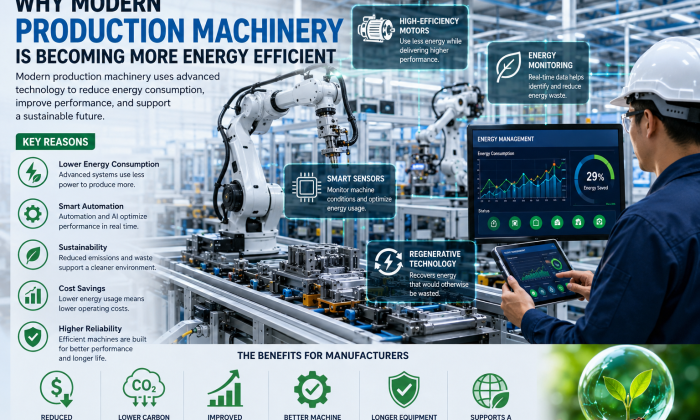
Energy efficiency has become one of the most important priorities in modern manufacturing. Across industries such as automotive production, food processing, electronics manufacturing, pharmaceuticals, packaging, and metal fabrication, companies are investing heavily in machinery that consumes less power while delivering higher productivity.
The shift toward energy-efficient production machinery is not simply a trend. It is a response to rising energy costs, stricter environmental regulations, sustainability goals, and increasing competition in global markets. Manufacturers are discovering that reducing energy consumption not only lowers operational expenses but also improves equipment reliability, product quality, and overall business performance.
A decade ago, production equipment was primarily designed to maximize output. Today, engineers are equally focused on minimizing energy waste. Modern machines are smarter, more connected, and capable of optimizing their own performance in real time.
As industrial facilities continue to adopt automation, digital monitoring systems, and advanced engineering solutions, energy efficiency has become a key feature rather than an optional advantage.
This article explores why modern production machinery is becoming more energy efficient, the technologies driving this transformation, the benefits for manufacturers, and what the future holds for industrial energy optimization.
The Rising Cost of Industrial Energy
Energy represents one of the largest operating expenses for manufacturing facilities.
Production lines rely on:
- Electric motors
- Pumps
- Compressors
- Heating systems
- Cooling systems
- Conveyors
- Robotic equipment
- Lighting infrastructure
When these systems operate continuously, even small inefficiencies can lead to significant costs over time.
For example, a factory running 24 hours a day may consume thousands of kilowatt-hours daily. A machine that reduces energy consumption by just 10% can save substantial amounts annually.
As electricity prices fluctuate worldwide, manufacturers increasingly seek machinery designed to reduce energy demand without sacrificing production capacity.
This financial pressure has encouraged equipment manufacturers to develop solutions that prioritize efficiency from the earliest design stages.
Environmental Regulations Are Driving Change
Governments around the world are implementing stricter environmental standards.
Manufacturers must now consider:
- Carbon emissions
- Energy consumption reporting
- Sustainability certifications
- Environmental compliance requirements
Industrial facilities are often among the largest consumers of energy in many regions.
As a result, businesses face growing pressure to reduce their environmental impact.
Modern production machinery helps companies meet these requirements by:
- Consuming less electricity
- Reducing greenhouse gas emissions
- Minimizing waste
- Supporting cleaner manufacturing processes
Energy-efficient equipment enables factories to comply with regulations while maintaining competitive production levels.
Advances in Electric Motor Technology
One of the biggest reasons modern machinery uses less energy is the advancement of industrial motor technology.
Electric motors power most manufacturing equipment.
Traditional motors often operated at fixed speeds regardless of actual production demands.
This approach wasted energy because machines frequently ran at higher capacities than necessary.
Modern motors offer:
Variable Speed Control
Variable Frequency Drives (VFDs) allow motors to adjust speed according to workload requirements.
Instead of operating at maximum speed continuously, motors can slow down when demand decreases.
Benefits include:
- Reduced electricity consumption
- Less mechanical wear
- Lower maintenance costs
- Improved process control
High-Efficiency Motor Designs
New motor standards focus on minimizing:
- Heat loss
- Friction loss
- Electrical resistance
These improvements allow more electrical energy to be converted into useful mechanical work.
As a result, modern production machinery requires less power to achieve the same output.
Smart Sensors Enable Real-Time Optimization
Sensors have transformed industrial equipment.
Modern machinery continuously collects data about:
- Temperature
- Pressure
- Vibration
- Motor load
- Speed
- Energy consumption
This information allows machines to make intelligent adjustments automatically.
For example:
If a motor is running under low load conditions, the system can reduce power consumption instantly.
If excessive heat is detected, cooling systems can activate only when necessary.
Older machinery often operated using fixed settings regardless of changing conditions.
Smart sensors eliminate much of this waste by ensuring equipment uses only the energy required at any given moment.
Industrial Automation Improves Efficiency
Automation has become a major contributor to energy savings.
Modern production systems coordinate multiple machines simultaneously.
Instead of operating independently, equipment communicates through centralized control systems.
Benefits include:
Reduced Idle Time
Machines spend less time waiting between processes.
Better Resource Management
Materials, labor, and energy are used more effectively.
Optimized Production Flow
Production schedules can be adjusted automatically to maintain maximum efficiency.
Automation prevents unnecessary energy consumption while increasing overall productivity.
Artificial Intelligence Is Transforming Manufacturing
Artificial intelligence (AI) is increasingly integrated into production machinery.
AI systems analyze vast amounts of operational data and identify opportunities for improvement.
Examples include:
- Predicting equipment failures
- Optimizing machine settings
- Reducing waste
- Managing power consumption
AI algorithms can determine the most energy-efficient operating conditions for specific production tasks.
Rather than relying on fixed parameters, machines continuously learn and adapt.
This capability helps manufacturers achieve significant energy savings over time.
Predictive Maintenance Reduces Energy Waste
Poorly maintained equipment often consumes more energy.
Examples include:
- Misaligned components
- Worn bearings
- Air leaks
- Damaged belts
- Dirty filters
These issues force machinery to work harder.
Modern production equipment incorporates predictive maintenance technologies.
Sensors monitor equipment health and identify problems before major failures occur.
Benefits include:
- Improved efficiency
- Reduced downtime
- Longer equipment lifespan
- Lower repair costs
By maintaining optimal operating conditions, manufacturers avoid unnecessary energy losses.
Compressed Air Systems Are Becoming Smarter
Compressed air is widely used in manufacturing.
Unfortunately, traditional compressed air systems are notoriously inefficient.
Air leaks alone can waste large amounts of energy.
Modern production machinery incorporates advanced compressed air management systems that:
- Detect leaks automatically
- Optimize pressure levels
- Reduce unnecessary compressor operation
- Monitor air consumption continuously
These improvements significantly reduce energy waste.
Regenerative Energy Technologies
Many modern machines now recover energy that would otherwise be lost.
This process is known as regenerative energy recovery.
Examples include:
Regenerative Braking
Industrial robots and automated systems can capture energy during deceleration.
Instead of dissipating energy as heat, systems convert it back into usable electrical power.
Energy Recovery in Conveyors
Advanced conveyor systems recover energy when moving heavy loads downhill.
Hydraulic Energy Recovery
Modern hydraulic systems capture and reuse pressure energy.
These technologies improve overall system efficiency while lowering energy consumption.
Improved Machine Design and Engineering
Modern machinery benefits from decades of engineering advancements.
Manufacturers now use sophisticated simulation tools to optimize equipment designs before production begins.
Engineers analyze:
- Airflow patterns
- Heat transfer
- Structural loads
- Motion dynamics
- Power requirements
This approach enables the creation of machines that achieve greater performance with less energy.
Improved mechanical design often results in:
- Reduced friction
- Lower heat generation
- More efficient power transmission
- Better material utilization
Every small improvement contributes to overall energy savings.
Lightweight Materials Reduce Power Requirements
Modern equipment increasingly incorporates advanced materials.
Examples include:
- Aluminum alloys
- Composite materials
- High-strength steel
- Engineered polymers
Lighter components require less energy to move.
For automated systems, robotic arms, and high-speed production lines, reducing weight can significantly lower energy consumption.
At the same time, these materials often improve durability and reliability.
Heat Recovery Systems Are Becoming Common
Industrial processes generate large amounts of heat.
Historically, much of this heat was wasted.
Today, manufacturers are finding ways to reuse it.
Heat recovery systems can:
- Preheat incoming materials
- Warm production facilities
- Support other manufacturing processes
- Reduce boiler loads
By capturing waste heat, factories reduce overall energy requirements.
This contributes to lower operating costs and improved sustainability.
Digital Twins Improve Energy Management
Digital twin technology is gaining popularity in manufacturing.
A digital twin is a virtual representation of a physical machine or production line.
It continuously receives real-world operational data.
Manufacturers use digital twins to:
- Test efficiency improvements
- Simulate production changes
- Identify energy waste
- Optimize machine performance
Because adjustments can be evaluated virtually before implementation, companies can achieve better energy outcomes with lower risk.
Industry 4.0 Is Accelerating Efficiency
Industry 4.0 refers to the integration of:
- Automation
- Connectivity
- Data analytics
- Artificial intelligence
- Smart manufacturing
Production machinery is becoming part of connected industrial ecosystems.
Machines communicate with:
- Other machines
- Enterprise software
- Energy management systems
- Maintenance platforms
This connectivity allows factories to coordinate energy use across entire operations.
Instead of optimizing individual machines, organizations can optimize entire facilities.
The result is significantly improved energy efficiency.
Sustainability Goals Influence Equipment Purchases
Many organizations now have formal sustainability objectives.
Investors, customers, and stakeholders increasingly evaluate companies based on environmental performance.
As a result, manufacturers often prioritize machinery that:
- Reduces carbon emissions
- Minimizes energy consumption
- Supports environmental reporting
- Aligns with sustainability initiatives
Energy-efficient equipment helps businesses achieve these goals while maintaining profitability.
Renewable Energy Integration
Modern machinery is designed to work more effectively with renewable energy sources.
Factories increasingly use:
- Solar power
- Wind energy
- Energy storage systems
Smart production equipment can adjust operations based on energy availability.
For example:
A facility may schedule energy-intensive processes when solar generation is highest.
This flexibility improves overall energy utilization and reduces dependence on conventional power sources.
Lower Energy Consumption Improves Competitiveness
Energy efficiency provides direct financial advantages.
Manufacturers that consume less energy can:
- Reduce production costs
- Improve profit margins
- Offer more competitive pricing
- Increase operational resilience
In highly competitive industries, even small cost reductions can create significant advantages.
Energy-efficient machinery therefore becomes a strategic investment rather than merely an environmental initiative.
Employee Awareness and Energy Management
Modern machinery often includes user-friendly dashboards that display energy performance metrics.
Operators can see:
- Real-time power consumption
- Efficiency trends
- Production performance
- Equipment status
This visibility encourages better decision-making.
Employees become more aware of how operational practices affect energy usage.
As a result, organizations can develop stronger energy management cultures.
Challenges of Transitioning to Energy-Efficient Machinery
Despite the benefits, upgrading equipment presents challenges.
Common obstacles include:
Initial Investment Costs
Advanced machinery often requires significant upfront capital.
Training Requirements
Employees must learn new technologies and operating procedures.
Integration Complexity
New systems must work alongside existing infrastructure.
Data Management
Connected machinery generates large amounts of operational data.
Manufacturers must develop strategies to manage and utilize this information effectively.
Although these challenges exist, long-term savings often justify the investment.
Future Trends in Energy-Efficient Production Machinery
Several developments are expected to further improve efficiency:
AI-Driven Autonomous Optimization
Machines will increasingly make independent energy decisions.
Advanced Energy Storage
Factories will store and manage energy more effectively.
Next-Generation Motors
Motor efficiency will continue to improve.
Enhanced Robotics
Robots will consume less power while delivering higher performance.
Smart Grid Integration
Factories will interact dynamically with power networks.
Carbon-Neutral Manufacturing
Energy-efficient machinery will play a central role in achieving carbon neutrality.
These innovations will continue transforming industrial operations worldwide.
Conclusion
Modern production machinery is becoming more energy efficient because manufacturers face growing pressure to reduce costs, improve sustainability, and remain competitive in an evolving industrial landscape.
Advances in motor technology, automation, artificial intelligence, predictive maintenance, smart sensors, regenerative systems, digital twins, and Industry 4.0 technologies have dramatically improved the efficiency of modern equipment.
Unlike older machines that often operated at fixed settings and wasted significant amounts of energy, today’s production systems continuously monitor conditions, optimize performance, and minimize unnecessary consumption.
The benefits extend beyond lower electricity bills. Energy-efficient machinery improves reliability, reduces maintenance requirements, supports environmental compliance, enhances productivity, and contributes to long-term business success.
As technology continues to evolve, production equipment will become even smarter, more connected, and more sustainable. Companies that invest in these innovations today are positioning themselves for greater efficiency, stronger profitability, and a more resilient future in modern manufacturing.