
Table of Contents
- Introduction
- What Is Industrial Automation?
- The Evolution of Manufacturing Automation
- Why Manufacturers Are Investing in Automation
- Types of Industrial Automation Systems
- Robotics and Automated Production Lines
- The Role of Artificial Intelligence in Manufacturing
- Industrial IoT and Connected Factories
- Benefits of Industrial Automation
- Challenges and Risks of Automation Adoption
- Impact on Workforce and Employment
- Real Manufacturing Case Review
- Future Trends in Industrial Automation
- Best Practices for Successful Automation Projects
- Conclusion
- Frequently Asked Questions (FAQ)
Introduction
Manufacturing has undergone remarkable transformations throughout history. From manual labor and steam-powered machinery during the Industrial Revolution to highly sophisticated digital factories today, every technological leap has redefined how products are designed, produced, and delivered.
Among the most significant developments in recent decades is industrial automation. What was once considered an expensive luxury reserved for large corporations has become a critical component of modern manufacturing operations. Today, manufacturers of all sizes are integrating automation technologies to improve efficiency, increase productivity, reduce costs, and remain competitive in a rapidly evolving market.
Industrial automation is no longer limited to robotic arms welding car bodies on automotive assembly lines. It now extends to smart sensors, artificial intelligence, machine vision systems, predictive maintenance platforms, and interconnected production networks capable of making data-driven decisions in real time.
As global competition intensifies and customer expectations continue to rise, manufacturers are under increasing pressure to deliver higher-quality products faster and more efficiently. Automation has emerged as one of the most powerful solutions to these challenges.
This article explores how industrial automation is reshaping modern manufacturing, the technologies driving this transformation, the benefits and challenges involved, and what the future may hold for smart factories around the world.
What Is Industrial Automation?
Industrial automation refers to the use of technology, control systems, software, and machinery to perform manufacturing tasks with minimal human intervention.
The primary goal of automation is to increase efficiency while maintaining consistency, accuracy, and safety.
Automation systems can control various manufacturing processes, including:
- Assembly operations
- Material handling
- Packaging
- Inspection
- Quality control
- Machine operation
- Inventory management
Unlike traditional manufacturing methods that depend heavily on manual labor, automated systems perform repetitive tasks with precision and reliability.
Automation technologies often include:
- Programmable Logic Controllers (PLCs)
- Human Machine Interfaces (HMIs)
- Sensors
- Robotics
- Industrial IoT devices
- Artificial Intelligence systems
- Supervisory Control and Data Acquisition (SCADA) platforms
Together, these technologies create highly efficient production environments capable of operating around the clock.
The Evolution of Manufacturing Automation
Automation has evolved significantly over the past century.
Early Mechanization
During the early stages of industrialization, machines primarily assisted human workers by reducing physical labor.
Examples included:
- Steam-powered equipment
- Mechanical looms
- Conveyor systems
Although productivity improved, human operators remained responsible for most decisions and machine adjustments.
Fixed Automation Era
As manufacturing demand increased, factories introduced specialized equipment designed to perform specific tasks repeatedly.
Examples included:
- Automated bottling lines
- Stamping machines
- Conveyor-based assembly systems
These systems offered high production rates but lacked flexibility.
Programmable Automation
The introduction of computers transformed manufacturing.
Programmable systems enabled manufacturers to modify production processes without replacing entire machines.
Technologies such as CNC machines revolutionized industries by allowing automated precision machining.
Smart Manufacturing
Today’s factories represent the next stage of evolution.
Smart manufacturing combines automation with:
- Data analytics
- Cloud computing
- AI
- Industrial IoT
- Machine learning
Modern equipment can communicate, monitor itself, and support predictive decision-making.
Why Manufacturers Are Investing in Automation
Several factors are accelerating automation adoption worldwide.
Increasing Labor Costs
Many industries face rising labor expenses.
Automation helps manufacturers maintain profitability by reducing reliance on repetitive manual tasks.
Demand for Higher Productivity
Customers expect faster delivery times and consistent product quality.
Automated systems can operate continuously with minimal downtime.
Product Quality Requirements
Automation reduces human error and ensures repeatable processes.
This consistency is particularly important in industries such as:
- Automotive manufacturing
- Pharmaceuticals
- Electronics
- Food processing
Labor Shortages
Many regions face difficulties finding skilled manufacturing workers.
Automation helps address workforce gaps while maintaining production capacity.
Competitive Pressure
Manufacturers that fail to modernize risk losing market share to competitors using more efficient production methods.
Types of Industrial Automation Systems
Industrial automation can be categorized into several major types.
Fixed Automation
Designed for high-volume production of identical products.
Characteristics:
- High speed
- Low flexibility
- Significant initial investment
Examples:
- Automotive assembly lines
- Beverage bottling systems
Programmable Automation
Suitable for batch production.
Machines can be reprogrammed to manufacture different products.
Examples:
- CNC machining centers
- Automated welding systems
Flexible Automation
Allows rapid switching between products with minimal downtime.
Common in industries requiring product customization.
Examples:
- Flexible manufacturing systems
- Robotic production cells
Integrated Automation
Combines multiple automation technologies into a unified production environment.
Examples include smart factories where machines, sensors, and software communicate seamlessly.
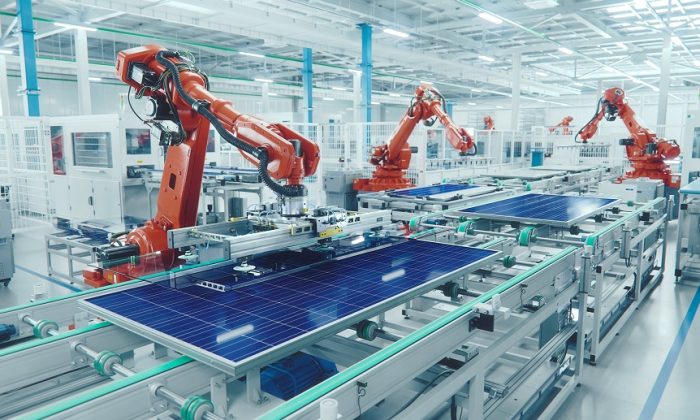
Robotics and Automated Production Lines
Industrial robots have become symbols of manufacturing automation.
Modern robots perform tasks such as:
- Welding
- Painting
- Assembly
- Packaging
- Material transport
- Quality inspection
Advantages of robotics include:
Precision
Robots consistently perform tasks with exceptional accuracy.
Speed
Automated systems often complete tasks faster than human workers.
Reliability
Robots maintain performance over extended operating periods.
Safety
Dangerous or hazardous operations can be assigned to robotic systems.
Collaborative robots, often called cobots, represent a growing trend.
Unlike traditional industrial robots, cobots are designed to work safely alongside human employees.
The Role of Artificial Intelligence in Manufacturing
Artificial Intelligence has become one of the most transformative technologies in industrial automation.
AI enables machines to:
- Analyze production data
- Detect anomalies
- Predict failures
- Optimize processes
- Improve quality control
Predictive Maintenance
AI can identify early signs of equipment deterioration.
By analyzing sensor data, algorithms detect patterns associated with future failures.
Benefits include:
- Reduced downtime
- Lower maintenance costs
- Improved equipment reliability
Automated Quality Inspection
AI-powered vision systems can inspect products faster and more accurately than manual inspection methods.
These systems detect:
- Surface defects
- Dimensional inaccuracies
- Assembly errors
Process Optimization
Machine learning algorithms continuously analyze production data to identify efficiency improvements.
Industrial IoT and Connected Factories
The Industrial Internet of Things (IIoT) connects machines, sensors, and systems through digital networks.
IIoT enables real-time visibility across manufacturing operations.
Common IIoT applications include:
- Machine monitoring
- Energy management
- Inventory tracking
- Predictive maintenance
- Production analytics
Smart sensors continuously collect data such as:
- Temperature
- Pressure
- Vibration
- Humidity
- Energy consumption
This information supports faster and more informed decision-making.


Benefits of Industrial Automation
Industrial automation offers numerous advantages.
Increased Productivity
Automated systems operate continuously with minimal interruptions.
Many factories achieve significant output increases after implementing automation technologies.
Improved Product Quality
Automation ensures process consistency and reduces variability.
This results in fewer defects and less rework.
Reduced Operating Costs
Although automation requires investment, long-term savings often include:
- Lower labor costs
- Reduced waste
- Improved energy efficiency
Enhanced Workplace Safety
Automation reduces worker exposure to dangerous environments.
Examples include:
- High-temperature processes
- Heavy lifting
- Hazardous chemicals
Better Data Visibility
Managers gain access to real-time operational insights.
This visibility supports faster problem resolution and strategic planning.
Challenges and Risks of Automation Adoption
Despite its advantages, automation also presents challenges.
High Initial Investment
Purchasing automation equipment often requires significant capital expenditure.
Smaller manufacturers may find adoption difficult without careful planning.
Integration Complexity
New technologies must integrate with existing systems.
Compatibility issues can delay implementation.
Cybersecurity Concerns
Connected factories face increasing cybersecurity risks.
Manufacturers must protect systems from unauthorized access and cyberattacks.
Skill Gaps
Advanced automation requires personnel with specialized technical expertise.
Training becomes essential for successful implementation.
Impact on Workforce and Employment
One of the most debated aspects of automation involves employment.
Some fear automation will eliminate manufacturing jobs entirely.
The reality is more nuanced.
Automation often replaces repetitive tasks rather than entire occupations.
Meanwhile, new roles emerge in areas such as:
- Robotics maintenance
- Data analytics
- Automation engineering
- AI system management
- Industrial cybersecurity
Employees increasingly transition from manual labor to higher-value technical responsibilities.
Successful organizations invest heavily in workforce development to support this transition.
Real Manufacturing Case Review
Electronics Manufacturing Facility
A mid-sized electronics manufacturer experienced rising labor costs and increasing product demand.
Initial Challenges
The company faced:
- Manual assembly bottlenecks
- Quality inconsistencies
- Frequent production delays
Production output struggled to keep pace with customer orders.
Automation Strategy
Management implemented:
- Robotic assembly stations
- Automated optical inspection systems
- IoT-based machine monitoring
- Production analytics software
Results After One Year
The facility achieved:
- 38% increase in production capacity
- 45% reduction in assembly errors
- 30% decrease in quality-related rework
- Significant improvement in on-time delivery performance
Key Takeaway
The project demonstrated that automation can enhance both productivity and quality when integrated strategically.
Future Trends in Industrial Automation
The future of manufacturing automation continues to evolve rapidly.
Artificial Intelligence Expansion
AI will increasingly support autonomous decision-making.
Digital Twins
Digital replicas of manufacturing systems will enable virtual testing and optimization.
Edge Computing
Real-time processing at the machine level will reduce latency and improve responsiveness.
Autonomous Mobile Robots
Factories will increasingly use mobile robots for material transport and logistics.
Sustainable Manufacturing
Automation will play a major role in reducing waste, energy consumption, and environmental impact.
Best Practices for Successful Automation Projects
Manufacturers considering automation should follow several key principles.
Define Clear Objectives
Identify measurable goals such as:
- Increased output
- Reduced downtime
- Improved quality
Start with High-Impact Areas
Focus on processes with the greatest productivity improvement potential.
Invest in Employee Training
Workforce readiness significantly influences project success.
Prioritize Data Collection
Reliable data supports better decision-making and performance measurement.
Plan for Scalability
Automation systems should support future growth and technological expansion.
Monitor Performance Continuously
Regular evaluation ensures expected benefits are achieved.
Conclusion
Industrial automation is fundamentally reshaping modern manufacturing by transforming how products are designed, produced, monitored, and delivered. Through robotics, artificial intelligence, Industrial IoT, advanced analytics, and smart factory technologies, manufacturers can achieve unprecedented levels of productivity, quality, efficiency, and flexibility.
While automation introduces challenges such as implementation costs, cybersecurity risks, and workforce adaptation, the long-term benefits often outweigh these obstacles. Organizations that strategically embrace automation position themselves to compete effectively in an increasingly digital and globalized marketplace.
The factories of the future will not simply be automated—they will be intelligent, connected, adaptive, and capable of continuously optimizing themselves. Manufacturers that begin this journey today will be better prepared for tomorrow’s industrial landscape.
Frequently Asked Questions (FAQ)
What is industrial automation?
Industrial automation is the use of technology, software, robotics, and control systems to perform manufacturing processes with minimal human intervention.
Why is automation important in manufacturing?
Automation improves productivity, quality, safety, consistency, and operational efficiency while reducing costs and downtime.
What industries benefit most from automation?
Industries such as automotive, electronics, pharmaceuticals, food processing, logistics, packaging, and aerospace benefit significantly from automation technologies.
Does automation eliminate jobs?
Automation primarily replaces repetitive tasks. It also creates new technical roles involving robotics, maintenance, programming, analytics, and system management.
What is Industry 4.0?
Industry 4.0 refers to the integration of digital technologies such as AI, Industrial IoT, cloud computing, and automation into manufacturing operations.
What is predictive maintenance?
Predictive maintenance uses sensors and analytics to detect potential equipment failures before they occur, reducing downtime and maintenance costs.
How do smart factories work?
Smart factories use connected machines, sensors, software, and data analytics to monitor, optimize, and automate manufacturing processes in real time.
What is the future of industrial automation?
Future developments include AI-driven decision-making, digital twins, autonomous robots, advanced analytics, edge computing, and more sustainable manufacturing systems.